
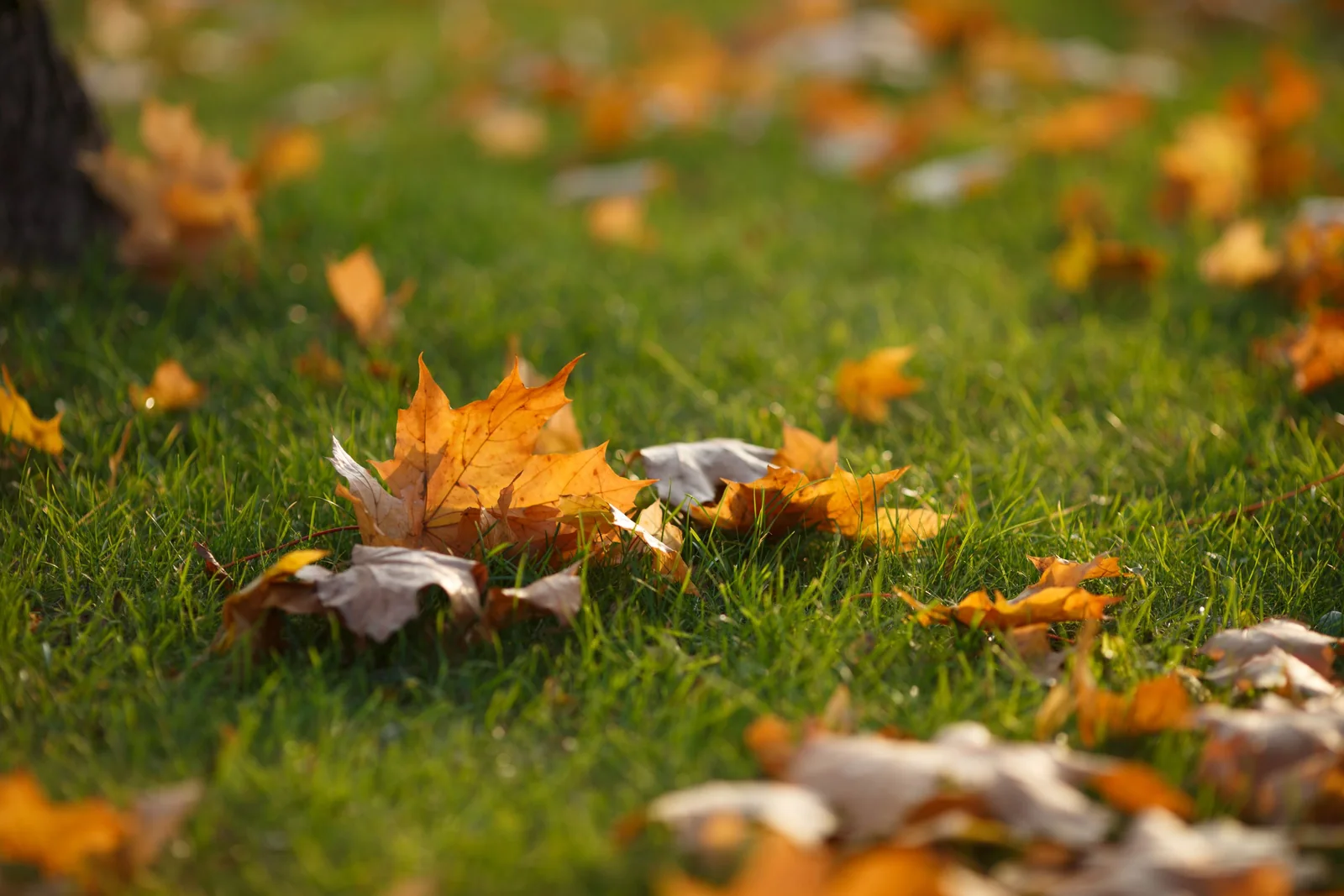
You do not have to choose between removing every leaf and leaving them all. Learn how to recycle autumn leaves without smothering your lawn, with practical guidance for Quebec.
Table of Contents7 sections
Table of Contents
The answer depends on how many leaves you have
By mid-October, falling leaves can turn yard care into a repetitive chore. Yet a healthy lawn does not need every small leaf removed. The goal is to keep the grass exposed to light without leaving a thick, compact blanket over it for winter.
The Montréal Botanical Garden recommends shredding leaves as they fall. If the layer becomes too thick, it recommends collecting and composting them. This is a useful middle ground between bagging everything and leaving a whole-leaf mat untouched. 1
When to mulch leaves in place
Leaf mulching means cutting leaves into small pieces with a mower so the fragments settle between grass blades. They contribute organic matter to the soil, but should not become another layer covering the lawn. University of Minnesota guidance favours this approach when the quantity can be adequately shredded. 2
Work when leaves can be cut effectively and the ground is firm enough for equipment. A sharp blade improves cutting. Another pass may be needed, but repeated traffic on waterlogged soil is not a sensible trade-off. Do not lower the mower to scalp the lawn just to pick up more leaves.
Check the result rather than counting the bags you have saved: most of the grass should remain visible. If fragments form clumps or still cover the blades, remove the excess. This visual check is more useful than a universal layer-depth rule, because leaf size and turf density vary.
When to remove the excess
Collect leaves when they form thick piles, particularly when they are pressed against the ground and cannot be properly shredded. University of Minnesota guidance links excessive accumulation with smothering, delayed spring growth and conditions favourable to some snow mould diseases. A single leaf does not mean your lawn will become diseased. 2
Remove leaf cover from an area you intend to seed as well. Seeds need to reach the soil; spreading them onto a blanket of leaves is not adequate preparation. 3
Help shape what comes next for LawnFan
The app is not available yet. Join the interest list for the beta planned for winter 2026–2027, or choose the newsletter for lawn tips and new articles.
Which signup should I choose?
Beta interest list: For expressing interest in testing the upcoming app. The button opens the form on the home page; invitations and timing will be confirmed later. Access is not guaranteed, and this signup does not subscribe you to the newsletter.
Newsletter: For seasonal tips, articles and project updates by email. The button takes you to the form at the end of this article’s content. You explicitly choose to receive these emails; this does not request beta access.
A natural approach that keeps living spaces usable
You can maintain clear grass where people walk or play and recycle excess leaves elsewhere. Collected leaves can be composted or used as mulch in appropriate garden beds instead of automatically being treated as waste. 4
Different parts of a yard have different purposes. A play area should remain usable; a garden bed can accommodate organic mulch. For a carefully maintained lawn, mulching still works when small fragments settle into the canopy. For a lower-maintenance yard, removing only troublesome accumulations can be a reasonable starting point.
Three mistakes to avoid this fall
- Waiting for every leaf to fall while a thick mat is already building up.
- Confusing mulching with leaving large, whole leaves pressed against the grass.
- Claiming that leaves will replace every fertilizer application: their nutrient contribution depends on the trees and the site.
The goal is not a sterile-looking yard. It is visible grass without persistent clumps, and leaves reused where they can be helpful.
Your late-October takeaway
Mulch a moderate amount of leaves when mowing conditions allow it. Remove surplus material if the grass remains covered. Adjust your routine to what is actually falling in your yard, rather than an obligatory schedule. For cutting height, read our guide to the last mow before winter.
Sources and scientific guidance
1 — Montréal Botanical Garden: Lawn care calendar.
2 — University of Minnesota, Turfgrass Science: Do you really need to rake all your leaves?, 2017.
3 — University of Minnesota Extension: Dormant seeding, reviewed 2025.
4 — University of Minnesota Extension: Late Fall Lawn Care, 2025.
This guidance concerns cool-season lawns. It is not a report of weather conditions in your neighbourhood on October 19, 2026.